
Hello my fellow artist friends, it’s been a minute!
A lot has happened since I wrote my last blog post and I won’t bore you with the details. I do have, however, a big news I want to share with you: in January I started the Society of Botanical Artists (SBA) Distance Learning Diploma Course (DLDC)!
I thought rather than keeping the experience to myself, I would record it as it unfolds—one assignment at a time, and share it with you. Not just the finished work, but the hesitations, the small discoveries, the frustrating moments, the overwhelming moments, the happy and not so happy moments…all of it
Of course I can’t disclose the details of the course, but I can show you my own journey and, if you’re thinking of doing the course yourself, hopefully you’ll find these insights helpful.
This course is something I’ve wanted to do for a very long time; however, I’ve always felt I wasn’t ready, wasn’t good enough. Every time I thought about enrolling, my inner critic had a field day! “Really?” he would say, “have you looked at your work? what makes you think you’re remotely good enough to apply?”.
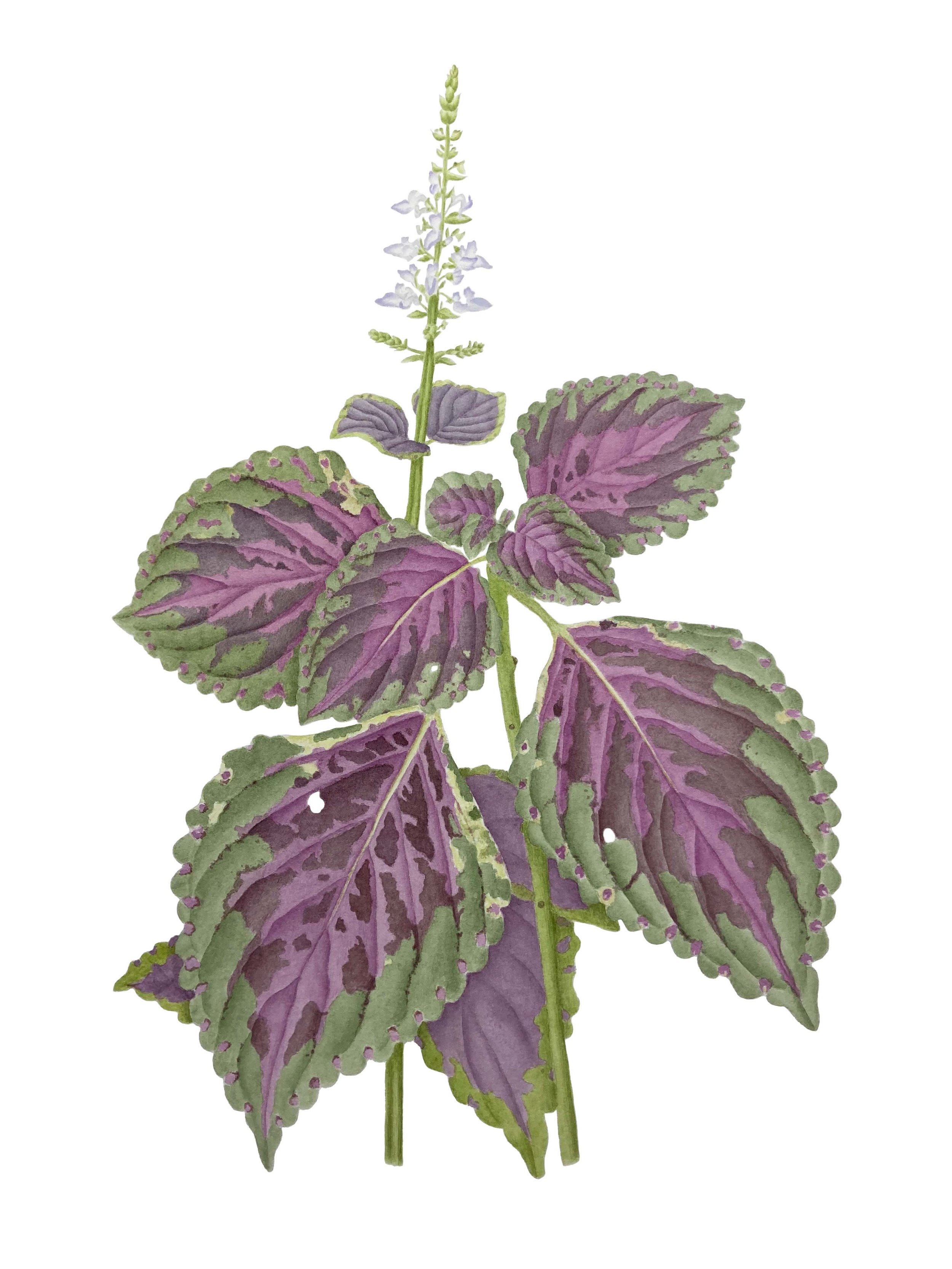
The painting I submitted in my application, Coleus
The application process itself felt daunting too—submitting a piece of work and not knowing what the outcome would be. It’s a vulnerable thing, putting something you’ve created out there to be judged.
But at some point, something shifted. Or maybe I just got tired of listening to that voice.
So I applied.
I was really looking forward to starting the course, but when the moment finally came to begin the first assignment, I felt something unexpected: hesitation.
Not because I didn’t want to start, but because I suddenly felt the weight of it. This wasn’t just another painting or drawing. It felt like the beginning of something more structured, more intentional… and, in a way, more vulnerable.
Learning to See Through Tone
I think I underestimated this first assignment.
When I opened the course binder and read through the requirements, it didn’t seem overly complicated—just drawing, after all. No colour yet. No complex compositions.
And yet, as I started, I realised very quickly that this assignment wasn’t simple at all.
It was foundational.
The Assignment
Assignment 1 was entirely focused on drawing and tone- the basis of a good botanical painting.
What surprised me most was how much this assignment forced me to slow down.
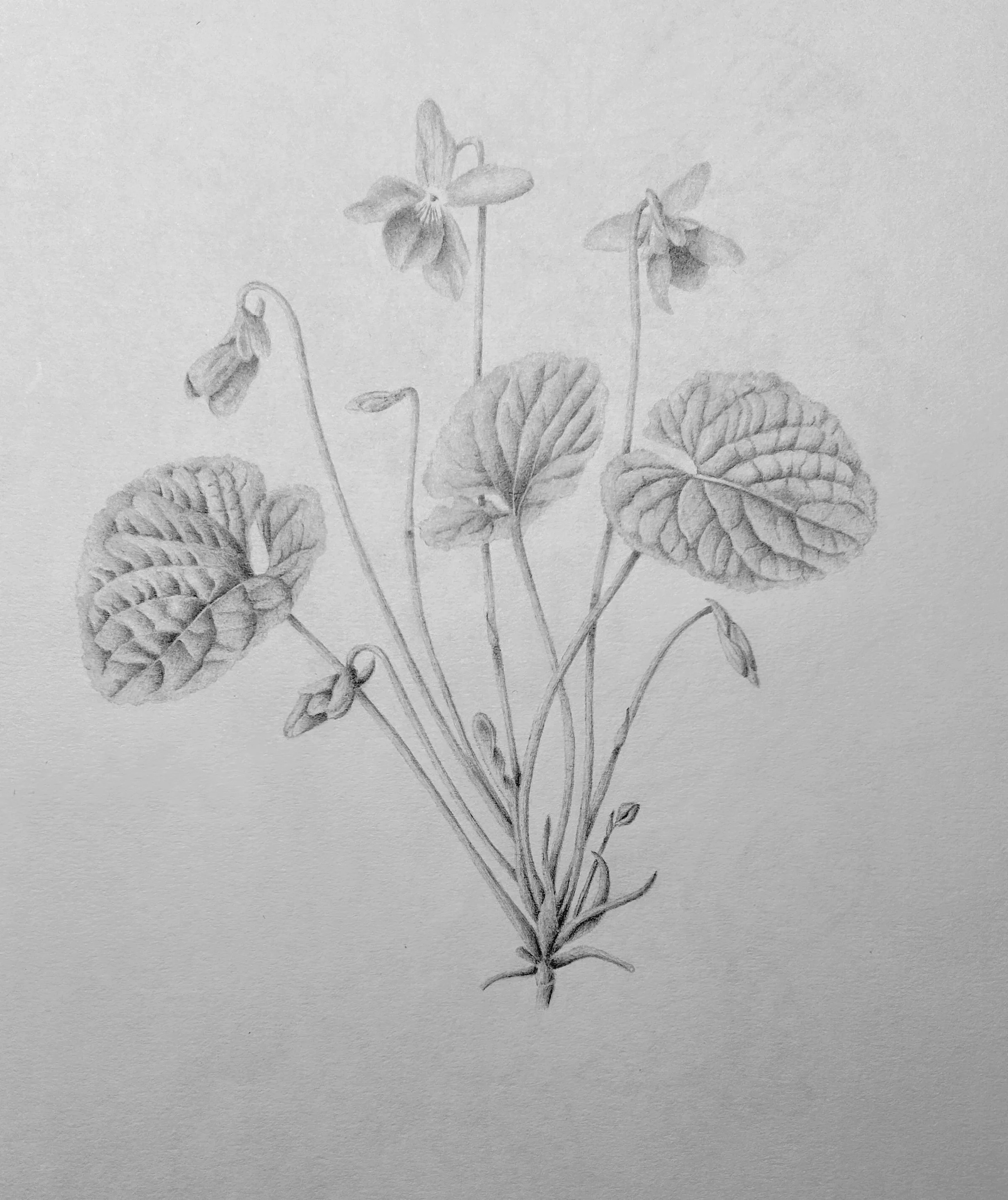
Viola odorata, tonal study for assignment 1
I found myself constantly questioning:
Am I drawing what I see, or what I think I see? And more often than I expected, it was the second.
The Challenge of Tone
The tonal study was where things became even more interesting.
The idea is simple: translate your subject into a full range of tones. But in practice, it requires a completely different way of looking.
Almost like turning your subject into a black and white photograph in your mind.
I had to stop thinking in terms of “leaf” or “petal” and start seeing shapes of light and dark instead. It’s such a subtle shift, but it changes everything.
Patience, More Than Skill
If I had to name the biggest challenge in this assignment, it wouldn’t be technique—it would be patience.
Building tone gradually, keeping the shading smooth, resisting the urge to rush… all of it requires a level of control that feels very deliberate.
There were moments where I wanted to jump ahead, to finish faster, to “complete” the drawing.
But this assignment doesn’t reward speed. It rewards attention.
What I Learned
This first assignment taught me something very clear:
Tone is everything.
It’s what gives form, depth, and realism.
But more than that, it taught me that observation is an active skill. It’s something that needs to be trained, not assumed.
The Final Pieces
Looking at my finished work, I can already see areas where I could improve, but I can also see a shift.
A greater awareness. A more careful approach.
And I think that’s exactly what this assignment was meant to do.
First Feedback
Receiving the tutor’s feedback was both reassuring and challenging.
There were aspects of the work that were received positively and it felt encouraging to know that the foundation is there.
At the same time, the feedback highlighted something I had already started to sense while working: a hesitation when it comes to tone.
A Small Shift
If there’s one thing I’m taking from the first critique, it’s this:
I need to be a little braver in my work.
It feels like a small adjustment, but I suspect it will make a significant difference in the assignments to come.
Moving Forward
This is only the first step in the course, but it already feels like a reset.
A reminder to slow down, to observe properly, and to build everything—colour included—on a solid understanding of tone.
I’m curious (and slightly nervous) to see how this foundation will carry into the next assignment.
I hope you’ve found this blog useful. Keep an eye on this page for more updates :-)
Thake care
Katia