
Hello my creative friends,
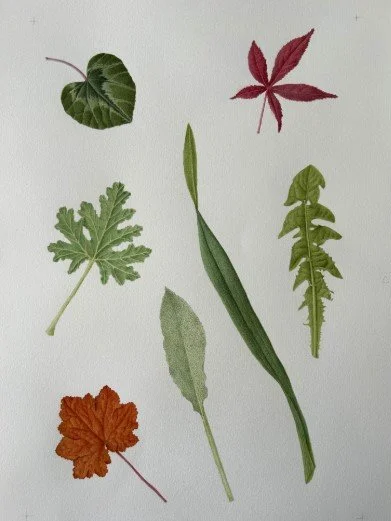
About six months have passed since the start of the DLDC with the SBA, and we're finally working with colour. Assignment 3 was, in fact, about painting leaves.
Introduction
They say that to overcome a particular fear, you should face it, and that is what I did with this assignment, I faced my fear of painting leaves. Did I conquer that fear? I’ll get to that in a minute.
When I first read the assignment I thought it shouldn’t be too difficult to find different leaves to paint; however the problem was just that: there were too many leaves to choose from!
The initial excitement about the project quickly turned into a slight panic. Which leaves should I pick? Somehow, once I picked a leaf, it immediately looked too difficult to paint, or too easy, or too big, too small… Not to talk about the coloured leaves! Which ones should I choose?
Choosing My Subjects
After many trips to the garden centre, to fields, parks and my uncle’s garden, I settled on my 7 leaves: Pelargonium graveolens, Cyclamen hederifolium, Acer palmatum 'Atropurpureum', Taraxacum officinale, Cymbidium, Stachys byzantina, Heuchera ‘Forever Red’.
These leaves would give me a variety of shapes and textures. I really wanted to paint a Taraxacum leaf, so that was one of the first ones I chose. However, those leaves wilt very quickly, so to have a fresh specimen to draw and paint I brought a plastic container with me on my leaves-scavenging walks. I placed a wet kitchen towel in the container so that the leaves would stay fresh for longer, and I picked a few leaves so I would have a selection to choose from.
The cyclamen was easier as I have the plant on my balcony, and I also bought the Cymbidium, the Acer (which will be donated to my uncle’s garden) and the Heuchera (which sadly lasted only just long enough for me to paint it).
Looking Beyond "Green"
Once I had chosen my final seven leaves, the next step was to observe them. One important aspect of botanical painting is actually spending some time observing your subject. If you look very closely with a magnifying glass or a loupe, you will discover so much more about your subject than if you just take a quick look.
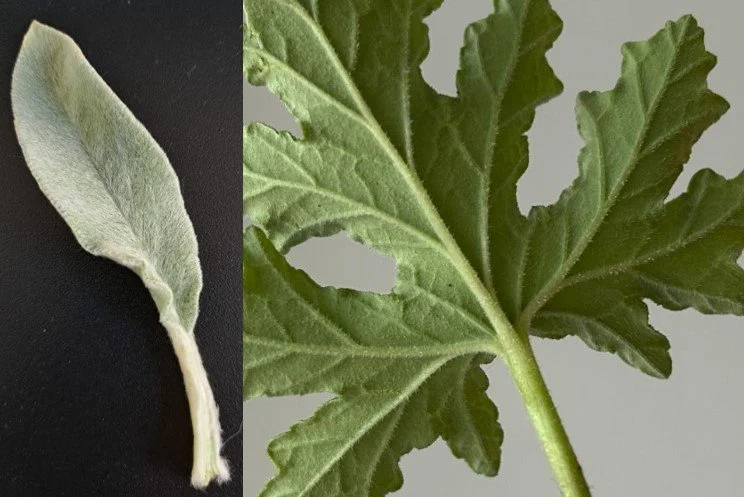
Here you can see the hairy surface of the Stachys and the small hairs on the back of the Pelargonium
On closer inspection, for example, I could see that the back of Pelargonium leaf had little tiny hairs growing from the veins (which were raised from the leaf surface). The hairs of the Stachys were growing in different directions and the petiole of the Heuchera also had tiny hairs which I hadn’t noticed before.
The Biggest Challenges
Although every leaf came with its own challenges, the biggest challenge for me was how to render the hairy surface of the Stachys. These leaves have grey hairs that go in different directions.
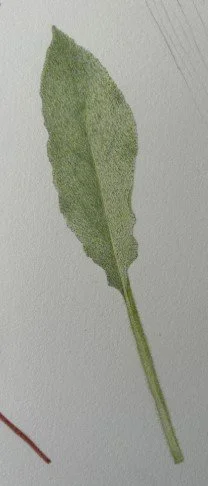
Stachys (Lamb’s ears)
There are different ways to depict hairs, and I chose the technique where you paint a wash with the green-grey colour of the hairs and then, with dry brush, you apply short strokes with a green colour to give the impression that this is actually the colour of the leaf behind the hairs.
I’m not sure this is making sense, but you have to think in a topsy turvy way.
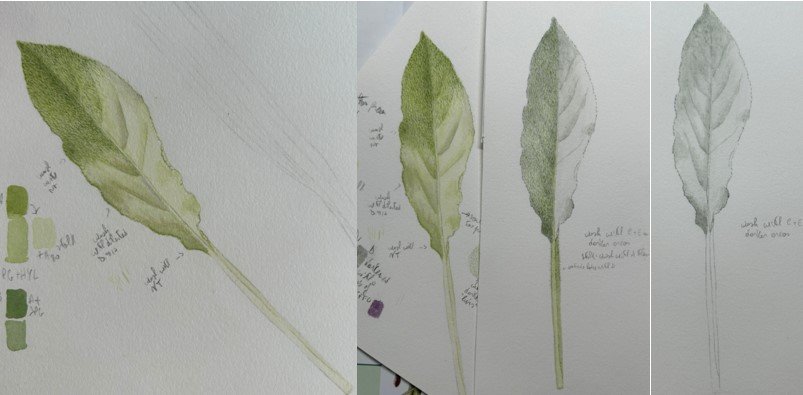
Stachys test painting and colour mixes
Whenever I’m faced with a challenge like this, I don’t start painting directly on my final composition. Instead, I do a "test run" on another piece of paper (the same paper I use for the final painting) to see which technique works best.
I must say I was a little frustrated at first because I couldn’t quite get the texture right, or the colour would turn out too green. But I kept practising the technique, and in the end I just thought I’d go for it.
I’m quite happy with how the leaf turned out.
Small Wins Along the Way
I like all the leaves I've painted, but I suppose the Cymbidium leaf is the one I like most. It has a lovely sense of movement in its twists, and I also like its colour and finished appearance. I managed to get the green dark enough and convey the fine veins and the subtle colour differences between the top (adaxial) and bottom (abaxial) of the leaf blade.
What I Learned
This assignment taught me to slow down and truly observe my subject. I mixed many different greens and discovered the versatility of Perylene Green and Green Gold! I'll be sharing my favourite colour mixes in a future post.
By taking detailed notes in my sketchbook, I learned how to observe a leaf properly, paying attention to its shape, margins, venation, and so on.
In future, I will apply what I have learned in this assignment—careful observation, colour mixing, and technique testing—to the other assignments and to my personal work.
Try this yourself
Before starting your next painting, spend ten minutes observing your subject without picking up your brush. Notice the direction of the veins, where the colours change, and how the light falls across the surface. That extra time can completely change the finished painting.
Final Reflections
After about six weeks, I have a page of leaves that may not be perfect but makes me very happy. I always feared painting leaves because I considered them the most difficult thing to paint. But after painting not one or two, but seven (seven!), I think I have finally (almost) conquered my fear.
I say "almost" because I still think they can be a rather difficult subject. However, I now know that if I approach them with calm, patience, and careful observation, I too can paint a convincing leaf.
I know that I'll never look at leaves in quite the same way again. What once appeared to be a flat shape is now a world of textures, colours, veins, shadows, and subtle details waiting to be discovered.
The next assignment is all about flowers, and I’m so excited to get started!
Do you enjoy painting leaves, or do you avoid them whenever possible? I'd love to hear about your experience in the comments.
If you’re new to leaves painting and would like to have a go, you can try my Leaf Painting Tutorial for free, or download my How to Paint a Realistic Leaf Guide.
You can also find watercolour painting classes on my Skillshare page (if you don’t have a subscription you can still try it for free by using the link above)
And if you'd like more botanical art tips, tutorials and behind-the-scenes stories, don't forget to join my Newsletter and you’ll be the first one to know the latest news
Till next time,
Take care,
Katia