
Hello my creative friends,
The journey into the DLDC continues and it’s getting harder!
Assignment 4 was all about flowerheads, and in that post I said the next one would be the first to show a complete flower. Well, here it is! Assignment 5 is about painting the whole flower, including stems and leaves. For this I chose to paint a Dahlia pinnata ‘Lavender Perfection’.
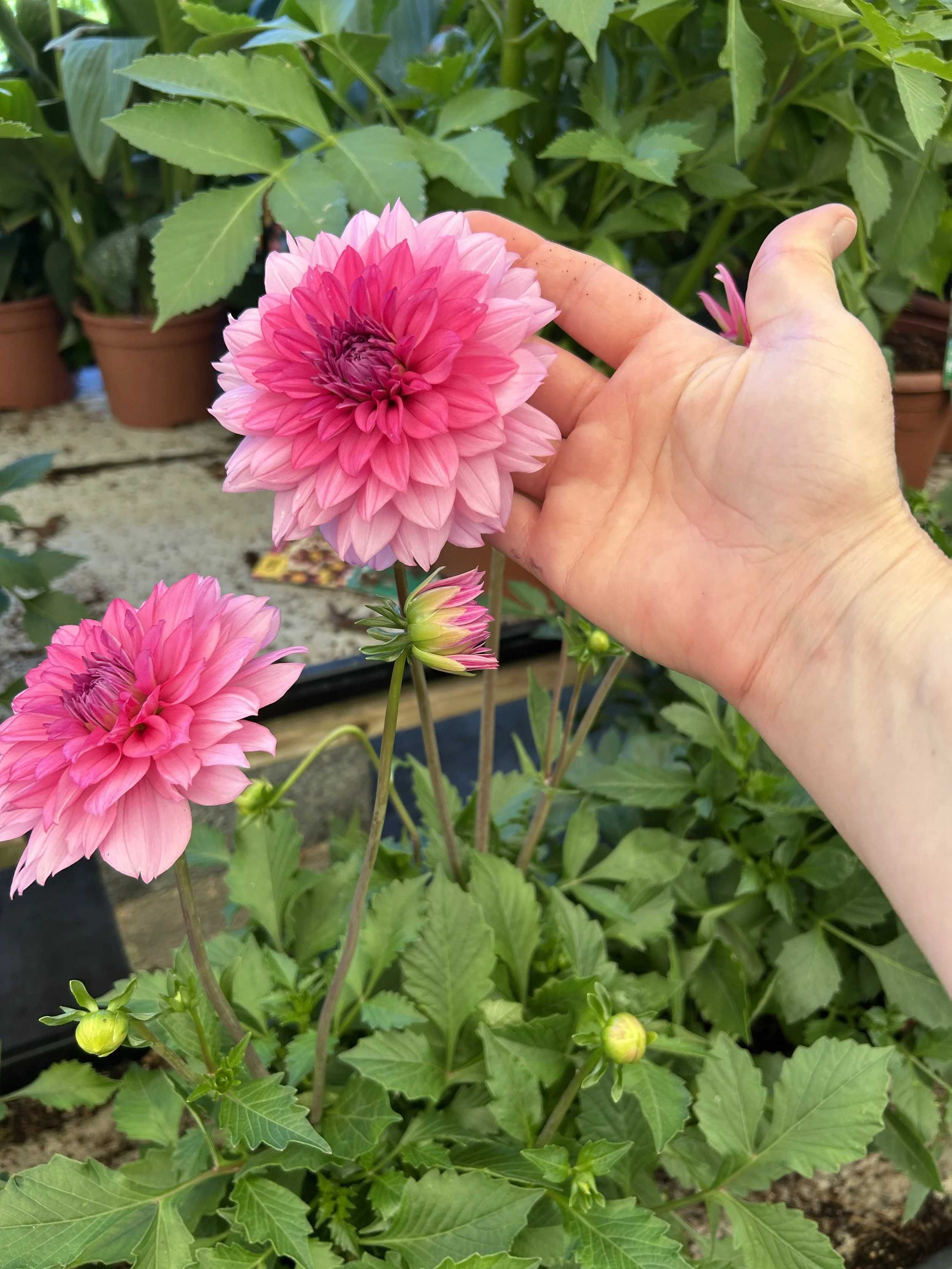
Not the easiest of the flowers I must admit, especially this early in the course, but I considered so many different flowers and none of them caught my eye like these Dahlias did.
It might have been the colour, I love all shades of pink, or the beautiful shape with the many petals, but I fell in love with it and I had to choose it.
Also, the flowers can be shown in several ways on one plant: buds, half-open, fully open, in profile and from the back.
[note: This post contains affiliate links, which means I may earn a small commission at no extra cost to you.]
Planning the composition
Once I finally chose the subject, I needed to start planning the composition. What I like to do is sketch the flower from different points of view and at different growing stages (this way I familiarize with the flower shapes and details), and then do a lot of thumbnail sketches with possible compositions. I must have done at least 20 different thumbnail sketches before I had a possible candidate to take forward.
At this point I do a more detailed drawing of each stem I want to use. I chose to do 3 stems, but Dahlias have more than one flower in each stem, so I could include a fully open flower as well as opening flowers and buds at different stages of maturity.
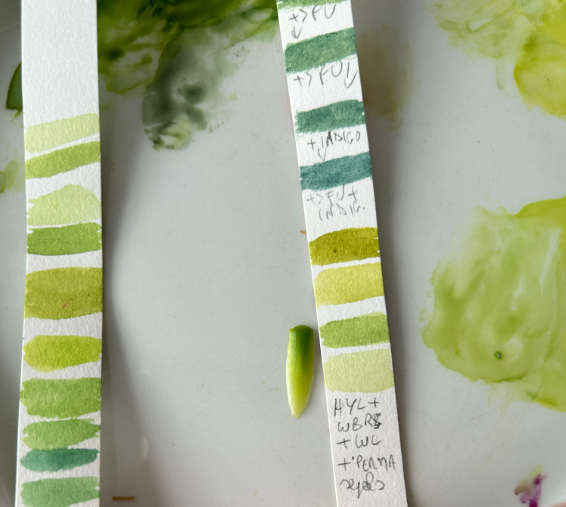
Colour mixing was also fun, as these are all hues that I love. I used primarily Winsor & Newton watercolours with one paint from Michael Wilcox
The composition has a triangular shape and I used an odd number of stems and placed the main flower on the top left point of interest (if you want to delve deeper on the subject of composition, I wrote about it in Mastering Composition in Watercolor: Rules to Follow and Break.) I also chose to include leaves at the bottom to balance the flowerheads at the top.
Painting in the heat
As it was very hot while I was painting this flower, I decided not to cut the flowers but to keep them in the plant for as long as possible so that I could prolong their life. I just had to bring the pot in and out of the flat every day!
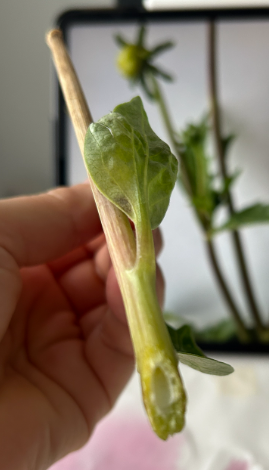
Eventually I had to cut some of them to better study the stem, which is hollow! I hadn’t realised this before now.
Observing the flower
One thing I loved about painting this flower is the “ombre” effect of the petals. They go from a really dark purple/pink in the centre, all the way to a light pink in the outer petals (on the mature flower). This was such fun to paint!
The biggest challenge
The petal layering was, however, also the biggest challenge. Especially in the centre the petals were small, dark and very dense so it took me quite a few hours of observing and squinting and looking through my magnifying glass…
One more step before the big jump
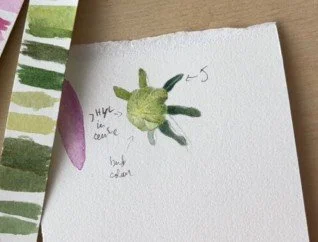
Before I jump into the final work I like to do a “test run” if you like, on a piece of the same paper I use for the final painting. This gives me the chance to test the colour mixes and also eventual new techniques.
Small wins
At one point, early on in the painting, I thought I had made a mistake in choosing this particular flower and that I’d never be able to complete the painting on time. However I managed to complete it (thanks to many early hours and weekends), and I’m happy with the result.
Looking back
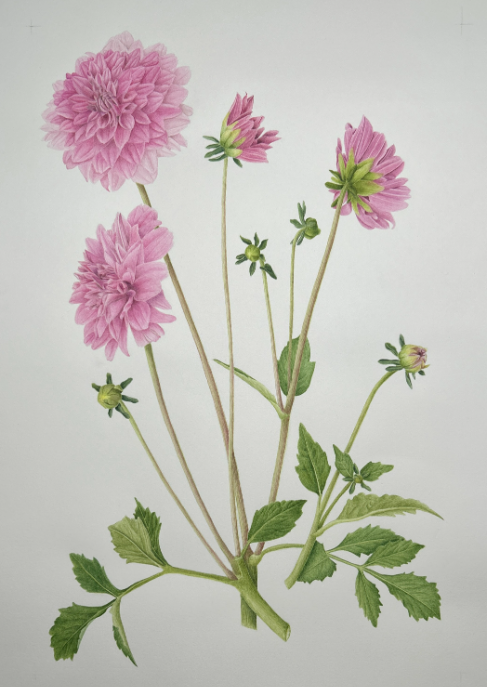
The finished painting
Looking back, I think choosing this Dahlia was the right decision after all! It certainly challenged me more than I had anticipated, especially when it came to painting all those tiny, overlapping petals, but it also taught me so much about observing a flower closely and understanding its structure.
One of the things I love about botanical art is that there is always something new to discover, even in a flower you think you know well. From the unexpected hollow stem to the beautiful gradation of colour across the petals, this Dahlia gave me plenty to think about and learn from.
And perhaps that is the real lesson of this assignment: sometimes the subjects that seem the most daunting at first turn out to be the most rewarding.
Now, on to Assignment 6! I wonder what challenges that one will bring…