Hello my creative friends,
Assignment 4 marked another exciting stage in the Distance Learning Diploma Course with the Society of Botanical Artists. After concentrating on leaves in the previous assignment, it was finally time to focus on one of the most celebrated subjects in botanical art: flowers.
I was really looking forward to this assignment because, finally, we could use colours other than green!
I must admit, I thought painting flowers would be easier than painting leaves. However, when I started working on this assignment I quickly realised this was no walk in the park. Beautiful subjects often come with their own unique challenges.
Choosing My Subjects
The first difficulty, as always, was choosing the flowers to paint. I wanted to represent a variety of shapes and textures, but not having a garden from which to pick flowers was rather working against me.
Of course, I didn't let this "small" setback get in the way. Instead, I went to visit my uncle, who is lucky enough to have a huge garden filled with flowers.
We also visited a garden centre, where I bought a few potted plants. It really makes a huge difference to have the plant in front of you while you paint it.
I ended up choosing flowers that I thought would look harmonious on the page, but that I thought I would enjoy painting too. The final seven were: Petunia × hybrida ‘Blue Star’, Rehmannia angulata (Chinese Foxglove), Dianthus ‘Tequila Sunrise’, Fuchsia magellanica, Phalaenopsis, Lilium, Cotyledon pendens.
I had also wanted to paint a rose, but the variety I had in mind was simply too complicated. With a full-time job, I have to be realistic about the time available to me. The rose was therefore discarded, as was Lilium regale, whose flowers were far too large for the assignment.
Composition and Observing the Flowers
Once the flowers were chosen, I needed to work on the composition.
I found it much more difficult to create a harmonious composition with flowerheads alone than with an entire plant. It took several days and many thumbnail sketches in my designated sketchbook before I finally settled on a layout that felt balanced and pleasing.
The next step was to observe the flowers. And I mean really observe them: studying their structure, petal arrangement, symmetry, colour variations, and all the tiny details that are so easy to overlook at first glance.
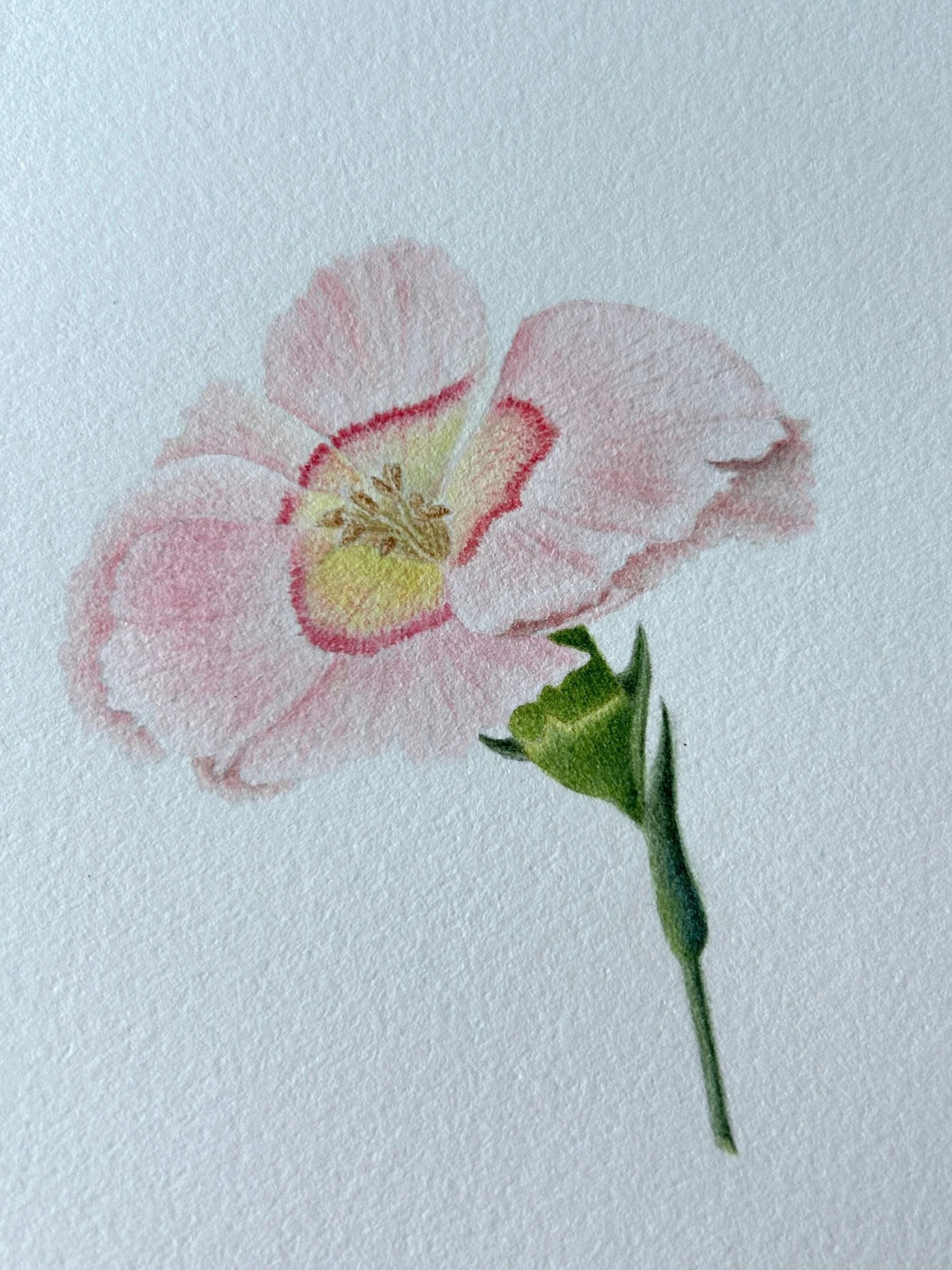
This is the Dianthus I painted, but here the pistil was still hidden
One thing I’ve never noticed before was that the Dianthus shows a very interesting process called protandry. This means that the pistil grows longer and curls outward over time. This is a process the flowers use to prevent self-pollination because the pistil matures and grows after the stamens have shed their pollen; that way they can be pollinated with pollen from another flower. Isn’t nature fantastic?
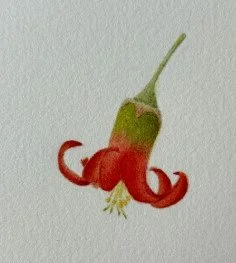
Cotyledon pendens
The Biggest Challenges
These flowers all had their challenges, but probably the most challenging was the Cotyledon pendens.
It was a small flower and looked easy enough, but looks can be deceptive. There is a transition from red to green where, if you’re not careful, you might end up creating a muddy colour, the petals are curled and the stamens are so small!
To keep the colours clean I used I drybrush technique; this way the paint stays on top pf the page and doesn't penetrate and mix in the paper fibers.
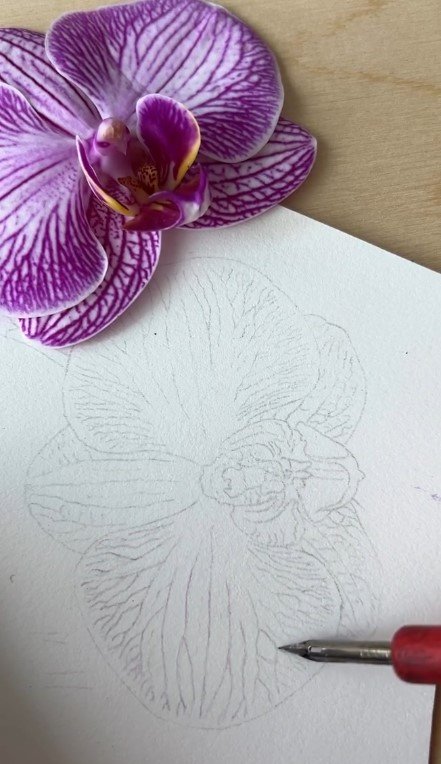
Using a mapping pen for the Phalaenopsis veins
The Phalaenopsis, was also complicated. The challenge there was (besides the intricate pattern) rendering the complex centre. For the pattern I used a mapping pen with watercolour to establish where the veins were, then I used a small brush and went over them again.
Testing and Practice Pieces
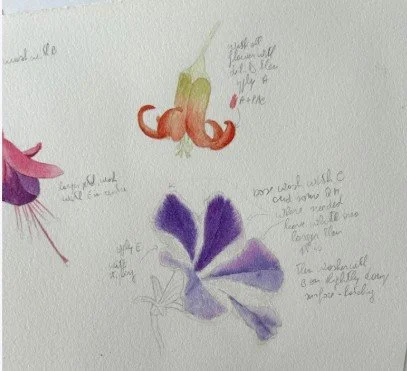
Preparatory studies
Of course, before starting on the final painting I always do some practise studies. It seems like you are using time that could be spent painting the final piece, but I have avoided many potencial problems by doing a practice piece first. Besides, I only do part of the painting, the part I think could be more problematic to paint.
Small Wins
While painting for this assignment I could tell that my technique is improving and I’m developing a better understanding of colour consistency and control. I still have a lot to learn, but I can see the difference already.
What I Learned
This assignment has taught me a lot. By tackling and resolving problems like recreating the intricate veins in the Phalaenopsis, or conveying depth in the Rehmannia, Lilium and Petunia, I have developed new techniques that I will be able to use in the future for other paintings.
It has also taught me to be patient and trust the process, and not to be put off by the “ugly stage”. All paintings go through that stage :-)
Try This Yourself
Pick a single flower and spend fifteen minutes studying it before making any marks on paper. Notice how the petals connect, where shadows appear, and how the colours shift from centre to edge.
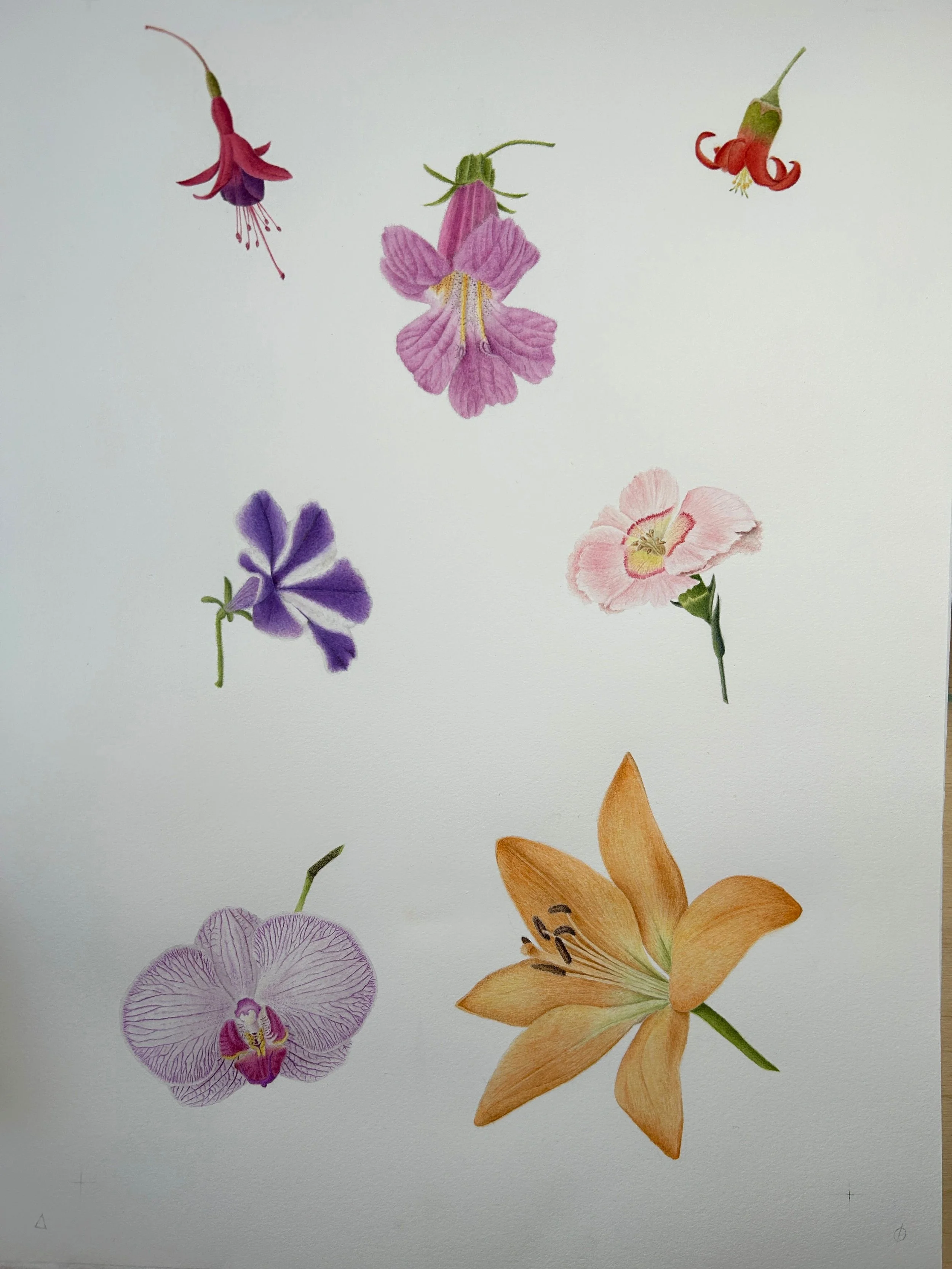
The final painting for assignment 4
Final Reflections
I absolutely loved painting this page of flowers, I learned a lot about each plant and about colour mixing. This assignment, together with the previous one, has prepared me to tackle the next one.
The next assignment will be the first one depicting a complete flower, and I can't wait to share that journey with you.
Have you ever started a project thinking it would be easy, only to discover it was much more challenging than expected? Let me know in the comments!